There is a guard that walks beside every one of us. It has no name, no face, and yet it has saved your life more times than you will ever know.
It is your ancient alarm system.
Long before cities, before language shaped into poetry and law, before even the first fire was tamed, our ancestors lived in a world that was not merely difficult, it was lethal. The tall grass could hide teeth. The quiet forest might hold a coiled death beneath a fallen branch. A moment’s inattention was not a minor mistake; it was an ending.
In such a world, the human mind did not evolve to be jovial. It evolved to survive.
The brain that remembers the storm
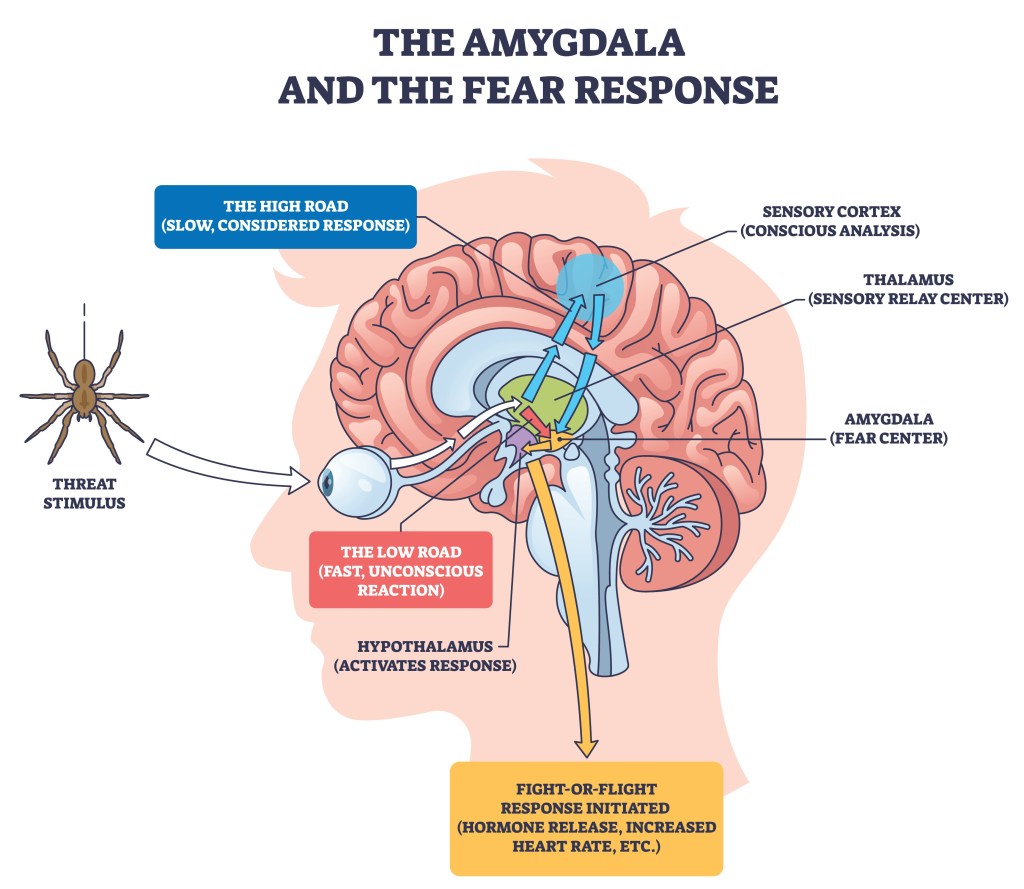
Modern neuroscience has given us names for what our ancestors simply felt. Deep within the brain sits the amygdala, an almond-shaped cluster that acts as a lookout. It is fast, far faster than conscious thought. When it detects a threat, it does not debate. It does not weigh probabilities. It sounds the alarm.
Research shows that negative stimuli, fear, anger, danger, are processed more rapidly and more intensely than positive ones. In controlled experiments, people consistently identify angry or fearful faces faster than happy ones. This is not a flaw but part of the design.
Psychologists call it the negativity bias.
Studies suggest that negative experiences are not only more attention-grabbing, but also more likely to be stored in long-term memory. One widely cited finding is that it can take multiple positive experiences, sometimes estimated at five or more, to psychologically outweigh a single negative one. In evolutionary terms, this imbalance makes perfect sense. Forgetting where you found berries might leave you hungry. Forgetting where the predator lurked would leave you dead.
So, the brain remembers the storm.
The world that changed, the mind that didn’t
The tragedy, if we can call it that, is that the world has changed faster than the brain.
Today, most of us will never face a charging predator or a venomous bite hidden in the undergrowth. Yet the ancient codes remains. The alarm system remains armed beneath the surface, scanning, interpreting, judging.
Only now, the threats are different: a critical email; a dismissive glance; a harsh word spoken in passing.
The amygdala does not always know the difference between a lion in the grass and a bruise to the ego. Both can trigger the same cascade: stress hormones released, heart rate rising, thoughts circling like vultures over a field of battle that exists only in the mind.
This is why a single insult can linger for years, replaying in quiet moments, while a dozen compliments fade like early morning mist.
It is why we lie awake at night reliving arguments we cannot change, or anticipating disasters that may never come.
The alarm is still ringing.
When protection becomes a prison
There is a cruel irony here. The very system that once ensured our survival can, in the modern world, erode our wellbeing.
Chronic activation of this alarm, what we now call stress, has measurable consequences. Studies link prolonged stress responses to increased risk of depression, anxiety disorders, cardiovascular disease, and impaired immune function. The body, built for short bursts of danger, was never meant to live in a constant state of alert.
Rumination, the habit of turning negative thoughts over and over in the mind, is one of the clearest expressions of this ancient system misfiring. It is the brain’s attempt to solve a threat that cannot be fought or fled. And so, it circles endlessly.
But there is no lion. Only the memory of one.
The quiet rebellion
And yet, the same brain that carries this ancient alarm system also possesses something extraordinary: the ability to reflect, to choose, to reshape its own patterns. Neuroscience calls it neuroplasticity, the brain’s capacity to change through experience.
We cannot silence the alarm entirely. Nor should we wish to. It is, after all, part of what has carried us this far. But we can learn to question it. To pause, in the moment of reaction, and ask: Is this a real danger, or an echo of an older world?
We can deliberately attend to the positive: to store it, revisit it, give it weight. Simple practices such as keeping a record of small victories, expressing gratitude, consciously recalling moments of connection have been shown in studies to reduce stress and improve overall well-being. They are, in a sense, acts of quiet rebellion against the ancient bias.
The watcher at the gate
Your alarm system is not your enemy. It is the guard at the gate, forged in a harsher age. But like any watchman, it can grow overzealous. It can mistake shadows for threats, whispers for war cries.
The task, then, is not to dismiss it, but to lead it. To recognise when it serves you, and when it does not.
Because the world you live in is no longer the one it was built for. And the greatest danger you face now is not the predator in the grass but the alarm that never learns the danger has passed.


 David Gemmell
Leave a comment